 Toutes les actualités
Interview with the Ecolo-Groen representatives on the Police Council


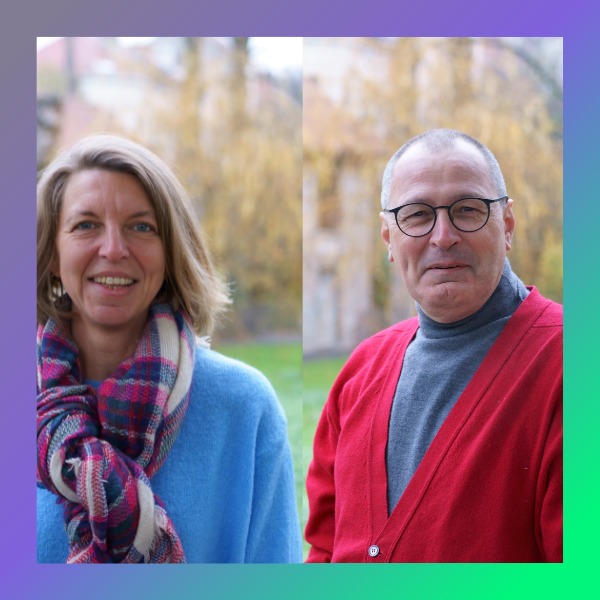
Caroline Joway, alderman for mobility, and Jean-Luc Debroux, local councillor, are both representatives on the Montgomery Police Council. We went to meet them to find out what the Police Council is all about and what goes on behind the scenes.
What is the police council?
The Police Council of the Montgomery Police Zone (or ZPM 5343, covering the municipalities of Woluwe-St-Pierre, Woluwe-St-Lambert and Etterbeek) meets in principle at least four times a year. The 23 members of the council are elected from among the municipal councilors of the three communes. It is chaired by the President of the Police College, who in turn is chaired by the mayors of the three municipalities concerned.
The Police Council carries out a number of tasks, the main ones being to determine the staffing levels of the local police force, appoint/promote/dismiss/pension staff members, approve the budget and annual accounts, and approve contracts for works/supplies/services.
What is the role of each of you?
Our role is to ensure that the ZPM 5343 is properly managed and that its mission/vision is respected. The Montgomery Police Zone's mission, in partnership with citizens and other stakeholders, is to contribute permanently and fundamentally to the safety, health and public tranquility of its entire territory.
Before each police council meeting, we carefully study the agenda. During the meeting, we don't hesitate to ask questions about the relevance of certain purchases or the budget. We also have the opportunity to question the police board on certain issues and problems encountered in the field, reported by residents or sometimes discovered in the press.
Why did you choose this mandate?
Caroline Joway:
From an early age, I've always been "fascinated" by police work, which is often criticized in the press. I wanted to get a closer look at the work of the local police, to better understand the management of a territory and the many challenges it faces. While the police advice is largely factual (validating many points of operation), it is no less interesting. Indeed, it's not uncommon for the police chief to brief councilors on subjects of interest, such as the staff training plan, new projects, statistics on bicycle theft or domestic violence... This allows me to become aware of certain (not always amusing) realities on the ground, and to commend the excellent work of the AMP in collaboration with the communes.
What's more, as an alderman responsible for mobility, it makes perfect sense for me to be a police advisor.
Jean-Luc Debroux:
For me, the police are first and foremost the men and women in uniform you regularly come across on the street. Human beings who can help you or punish you. In any case, they are representatives of the state and of law and order, whose multiple missions are often far more delicate and complex than you might think. Trust between citizens and law enforcement officers is at the heart of this very special profession, which is constantly evolving to keep pace with changes in society. If this trust is sometimes undermined when incidents occur, it seemed important to me, as a citizen and elected municipal official, to be part of this body for the democratic control of our police. Even if the police council remains above all a place for adopting technical and operational decisions, it also provides an opportunity for contact and rich exchanges with the representatives of a structure that is essential to the smooth running of our community. And it must be said here, loud and clear, that the current Chief of Police of our police zone, his management team and his men and women (611 people in all - broken down into 504 operational staff and 107 logistics staff!) regularly demonstrate their human qualities, as well as the depth of their reflections on their work, its evolution and their concern for its future while respecting the law and citizens.
What's the subject that's closest to your heart?
Caroline:
I'm particularly interested in the ZPM's awareness-raising and prevention work, especially with young people. Various actions are carried out with this in mind (stands, meetings with young people, in partnership with schools...). I find this particularly interesting.
The police zone also has a bicycle brigade and a horse brigade (in Etterbeek). These two "means of transport" allow easier contact (than by car) with the population.
I would also like to emphasize that the Chief of Police, Michael Jonniaux, is a man who seems to me to be deeply human, who has an undeniable vision and human values, and who is trying, with his whole team, to respond to the challenges and problems of today. And there are many of them! The initiatives taken by the ZPM all seem to me to be relevant.
Jean-Luc:
On a personal level, and over and above my mission to monitor the operations and resources made available to our police officers, I hope that the mindset and operating methods instilled by the current chief of staff of the Montgomery ZP will be as long-lasting as possible. While the core of our job is, of course, to maintain public safety and tranquility, the deeply humane way in which these missions are currently handled and implemented seems to me to be extremely valuable. A good recent example of this, in my view, is the participation of ZP staff in a training program on how to deal with victims, and more particularly victims of all forms of violence (sexual, domestic, etc.). A mantra: beyond the regal mission, always put people and their well-being at the center of their concerns, both internally and externally.
What are the major challenges facing this police zone?
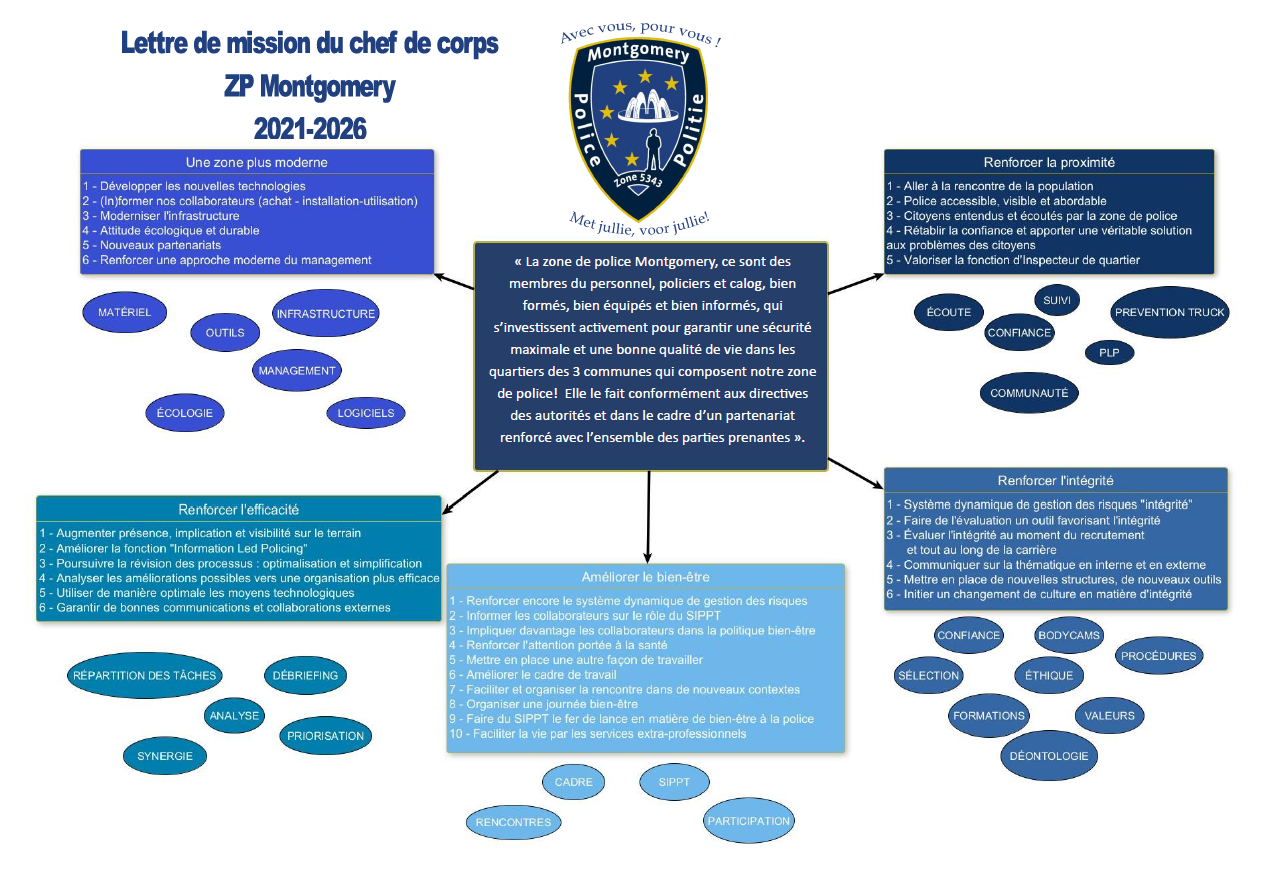
The challenges facing the Montgomery ZP are set out in the 2021-2026 mission statement issued by its Chief of Police (see image below), 1st Commissaire-divisionnaire Michaël Jonniaux, who wants a police zone that is close to its citizens, that listens to them, that solves their problems, that is modern and efficient, that pays particular attention to the well-being of its employees and ensures that they behave with integrity and respect. All of this is to enable us to implement the priorities of the 2020-2025 zone security plan in terms of road safety, public transport safety, curbing the phenomenon of robbery (whose development in the zone is considered worrying) and the fight against nuisance and incivilities. The main shadow hanging over this ambitious plan is budgetary capacity, which is currently limited by the economic situation (indexation of salaries, energy costs, the cost of new technologies and the services of certain suppliers, etc.). What's more, the financial capacities of the three communes in the area are only just able to keep pace, and compensate for federal and regional subsidies that are insufficient to finance the ever-increasing number of missions.